



Welcome back to Toronto Maids! Today we want to discuss a hot topic: AI and the future of house cleaning.
Just like any other cleaning company in Toronto, we have to adapt to the ever-changing technology and the options we have available to make our jobs easier and more efficient.
AI has quickly become a very important part of our lives and it’s also transforming residential cleaning. Here’s what AI means for Toronto homeowners and cleaning professionals in 2026.
Will AI Replace Human Cleaners? What We Actually See Happening
Around two years ago, a homeowner sent us a photo of her robot vacuum. It had gotten stuck under a couch for the second time in a week and she was really frustrated. This month, a client asked me directly: “Are we going to have robots cleaning our homes in five years?”
To be honest, we’re probably going to have robots cleaning our homes, but they won’t even be close to replacing humans. We know technology moves quickly but we’re still a long way from having robots that can clean homes the way humans can.
Last month, an American company launched an AI robot capable of performing cleaning tasks: the Isaac 1 by Weave, for a whopping $8000 USD. And even though it’s impressive, it’s still very limited at this point. It can only fold clothes, make beds, and do some light tidying up.
This is still very far away from what humans can do: sweeping and mopping floors, wiping countertops, vacuuming furniture, doing laundry… and most importantly: fixing problems as they come.
Every home has its own challenges. Choosing the right cleaning product for a sensitive material or fabric, or vacuuming and mopping hard-to-reach areas, cleaning and wiping delicate items, or figuring out where to put the trash. And of course, quickly solving issues on the go, communicating with the manager and hearing what our customers need.
AI is still far away from doing any of this to a human standard.
Why AI Matters for Modern Cleaning Services
For the past 3 – 5 years, AI has slowly started to be implemented in many operational services and in our daily lives. According to the Government of Canada, in the second quarter of 2026, 19.2% of businesses reported using AI to produce goods or deliver services.
In the cleaning industry, AI can be useful to analyze large amounts of data, like customer phone calls, satisfaction surveys or booking patterns. This allows us to predict when clients need service or where we need to improve our performance.
For example, if 20 customers book a deep cleaning every three months, AI can help us flag this and suggest to them that they book again by week weight or nine. These little details are sometimes hard for humans to detect, especially if we’re talking about a large customer database.
And this also saves clients from forgetting and makes them feel like we’re thinking ahead and solving the issue for them.
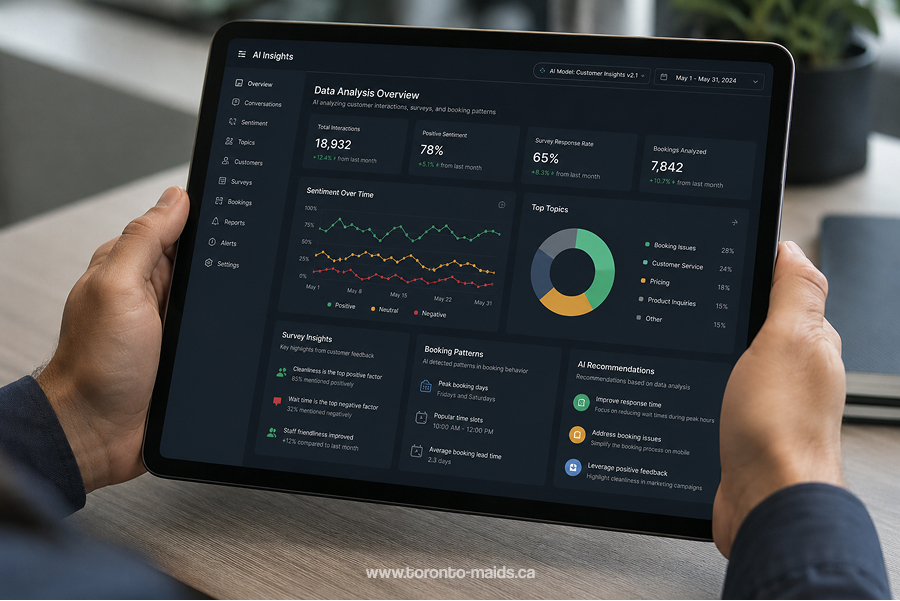
Also, sometimes AI is helpful for writing better and keep our tone consistent across our communications to customers, social media, and other forms of contact. Sometimes we use AI to create draft responses to client emails and then rewrite them in our own voice.
This speeds up the process and ensures we are consistent with our communication style while still preserving our own identity and human touch.
But here’s what AI still can’t do: it can’t tell the difference between laminate and granite just by looking. It can’t adjust pressure on a microfiber cloth. It can’t notice that a client’s allergies got worse and recommend a different cleaning schedule or use fragrance-free cleaning products.
AI can’t build trust by showing up consistently for years, only humans can.
The Real Role of AI in Toronto’s Cleaning Industry
When we look at house cleaning as a business, AI is useful in maybe 15 percent of what we actually do. Scheduling, client communication, route optimization, staff management.
A robot that maps your client’s home and calculates the fastest route saves money. But the other 85 percent still needs a human.
As we mentioned earlier, cleaning a bathroom with hard water buildup requires judgment. Our water here in Toronto can be rough. Someone needs to decide whether to use vinegar or citric acid based on what they see and touch. Someone needs to move that breakable item off the shelf before spraying the cabinet above.
Three weeks ago, a client’s teenage daughter left a note asking us to please use fragrance-free products because she’d developed a sensitivity. A robot wouldn’t have seen that note taped to the bathroom mirror. Our cleaner did, saved the note, and we switched everything that day.
What AI Definitely Can’t Do Yet
Adaptability is the real work. We cleaned a house once where the client had three cats and the furniture was arranged completely differently than the last visit. Someone moved it all.
We had to recalculate how to access the baseboards. It took an extra 15 minutes. No robot would have figured that out. No AI system would have suggested a different approach, or at least, not with the technology we have today.
Damage prevention is another one. We clean inside ovens as part of our deep cleaning and we use soft scrapers because we know that metal will damage the interior coating.
We’ve worked with people who scraped too hard. Once you damage the inside of an oven, that’s not coming back. A hiring company for robots would have to build in safety margins so large that the job would take three times as long because it wouldn’t know where to apply more or less pressure depending on the amount of grease buildup on that specific area. The human eye and judgment are faster.
Client relationships are still the biggest reason people hire us. One of our regulars has been with us for three years. She’s got mobility issues now, and she’s incredibly grateful when our team anticipates what she needs before she asks.
Last month, our cleaner noticed the grout in her bathroom was starting to fail and we let her know what was happening. We didn’t push a service we don’t offer. We just told her and she was grateful because she trusted us enough to listen.
The Future Probably Isn’t What Anyone’s Imagining
AI does make life easier for us and speeds up many tedious, repetitive processes. When the company is stronger, it creates more stability, better opportunities, and a healthier livelihood for everyone here.
In the future, we’re probably going to see more of what’s already happening. Cleaning services will use AI for administrative work. Smarter scheduling, more accurate pricing, personalized discounts…
We might also see robotic vacuums get genuinely good in the next decade. That’s a real possibility. However, we’re still far away from seeing a robot that cleans a whole Toronto home from top to bottom without human oversight.
The variables are too many and every home is different. Every client has different wants and needs.
Besides, every customer wants to feel heard. Our staff needs support, encouragement, coaching, and understanding. Problems need judgment. People need kindness.
Sometimes a customer isn’t just asking a question. Sometimes they’re stressed, overwhelmed, moving, dealing with family issues, or simply having a bad day. AI can process information but, fortunately, it cannot replace human interaction.
The future of house cleaning isn’t about AI replacing people, but about people working with better tools. That’s already happening and we see it every day.
If you’re worried about hiring a cleaning service because you think robots will take over, don’t be. The human touch is why people hire us. The knowledge is why we’re worth paying for. That part isn’t going anywhere.
For more on our cleaning services around the Greater Toronto Area, explore our standard cleaning service or learn about what deep cleaning actually includes versus regular maintenance. We also offer move-in and move-out cleaning if you’re planning a change. Questions about what service makes sense for your home? Get in touch.
We’ll be back soon!
 GET UPDATES
No charge. Unsubscribe anytime.
GET UPDATES
No charge. Unsubscribe anytime.
